The New Garden Hive
I waited to see if Hive 1 produced queen cells and then finally decided to split the colony and add a new queen as described in my last entry. Now I have more waiting to do.
I am now anxiously waiting to see if the colony has accepted the new queen. It is agony and I am constantly tempted to open the hive and see what is going on! I need reassuring all is well.
Day 0 - Nucleus hive bees split away from colony in hive 1
Day 1 - New queen introduced to nucleus 'nuc' hive.
Day 2 - Checked nuc and found two workers drowned in syrup, removed. Fondant still in place in cage
Day 3 - Bees not going in and out of the nuc but then any 'fliers' would have returned to hive 1. A single bee on an orientation flight. Three dead drones in grass at entrance and one being killed by a wasp. Waited to see if any more wasps. No sign of guard bees at tiny entrance. Opened top to find one syrup death and rescued another bee. A peep at the queen cage showed big hole in fondant. Resisted looking at frames but only just !
Day 4 - British Beekeepers Association Examination so I was distracted. I checked for further bee deaths outside the nuc but all fine and then (deep sign of paranoia) I went on my hands and knees and checked the mesh floor from underneath to see if there were loads of dead bees and possibly the queen. All fine.
Day 5 - 1st Inspection day! No dead bees outside the nuc and still no entrances and exits. I lifted off the crown board in a high state of anxiety and carefully removed a frame of stores so that I could gently check the queen cage. This had a number of dead bees in it and I hoped that this did not include a rejected queen as my friend Alison warned me that workers can sting a queen to death through the cage. On closer inspection the bees looked like workers. I progressed with the inspection and found the azure queen walking around happily with her subjects. Phew! I nearly cried I was so relieved. No queen cups had been made in the period before the queen's pheromone had percolated the hive. Eggs seen but of course no new larvae yet as they have not had time to emerge from the eggs. The brood from hive 1 has been nurtured and a few workers were hatching out. The next bit of waiting will be to see if the brood from the new queen is building up well enough to go into a full sized hive. Also to see if the workers have matured into foraging bees. I was working in the garden in the afternoon and delighted to see about 30 worker bees on their initial orientation flights around the hive.
Day 6 - No orientation flights but a small number of bees exiting and returning to the hive. No sign of pollen so assume that they are collecting nectar or water.
Day 7 - Awoke at 6.00 am worrying if there is enough space for the new queen to lay as the nuc had 3 frames of brood and 2 of stores from hive 1. Very small number of 'fliers' leaving and entering the hive as yesterday.
Day 8 - Again a small number of bees circling the nuc. Are they 'robbers' ? they do not seem to enter or exit so what are they up to? 2.30 p.m. An active little group of orienteers are flying and moving in and out of the hive. Phew, relief. However, there are also a few crawling bees with deformed wing virus contracted in hive 1 via the varroa mites. These bees have been excluded and will sadly die. Hopefully the MAQs treatment means that newer bees are not affected.
Day 9 - 11 - Minimal activity especially yesterday as it poured with rain continuously.
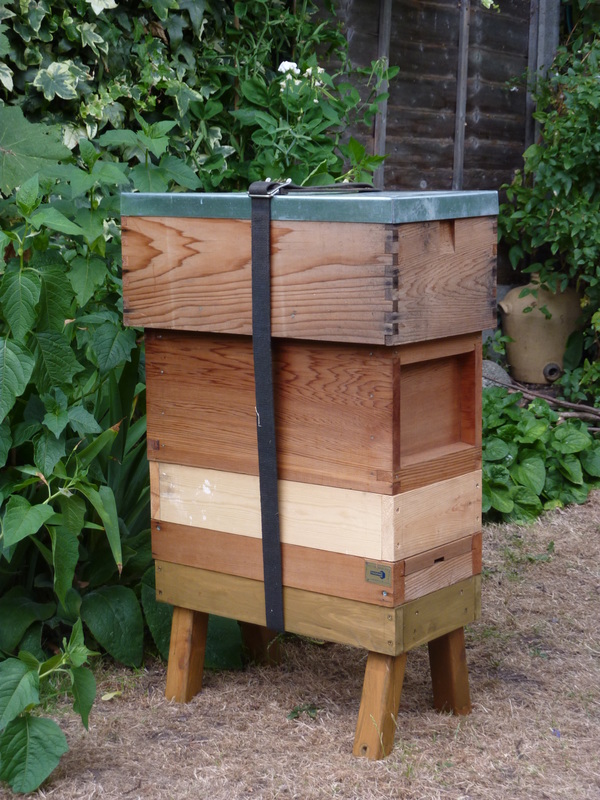
Day 12 - 2nd Inspection day. Moved a full sized hive close to the nuc. Did a complete check of the nuc and saw the queen and eggs. Bees on 4 seams. Sadly a few on the mesh floor had deformed wing virus. I trust the newer hatched ones will be fine. Moved the frames from the nuc into the new hive with freshly waxed frames either side. They had eaten all the syrup so I topped it up and closed up the hive leaving a small entrance to make it easier to defend from intruders. From now on it will be external checks and syrup top up and weekly full inspection with the hope that there is enough time for this hive to build up sufficient numbers and health to see it through the winter.
I waited to see if Hive 1 produced queen cells and then finally decided to split the colony and add a new queen as described in my last entry. Now I have more waiting to do.
I am now anxiously waiting to see if the colony has accepted the new queen. It is agony and I am constantly tempted to open the hive and see what is going on! I need reassuring all is well.
Day 0 - Nucleus hive bees split away from colony in hive 1
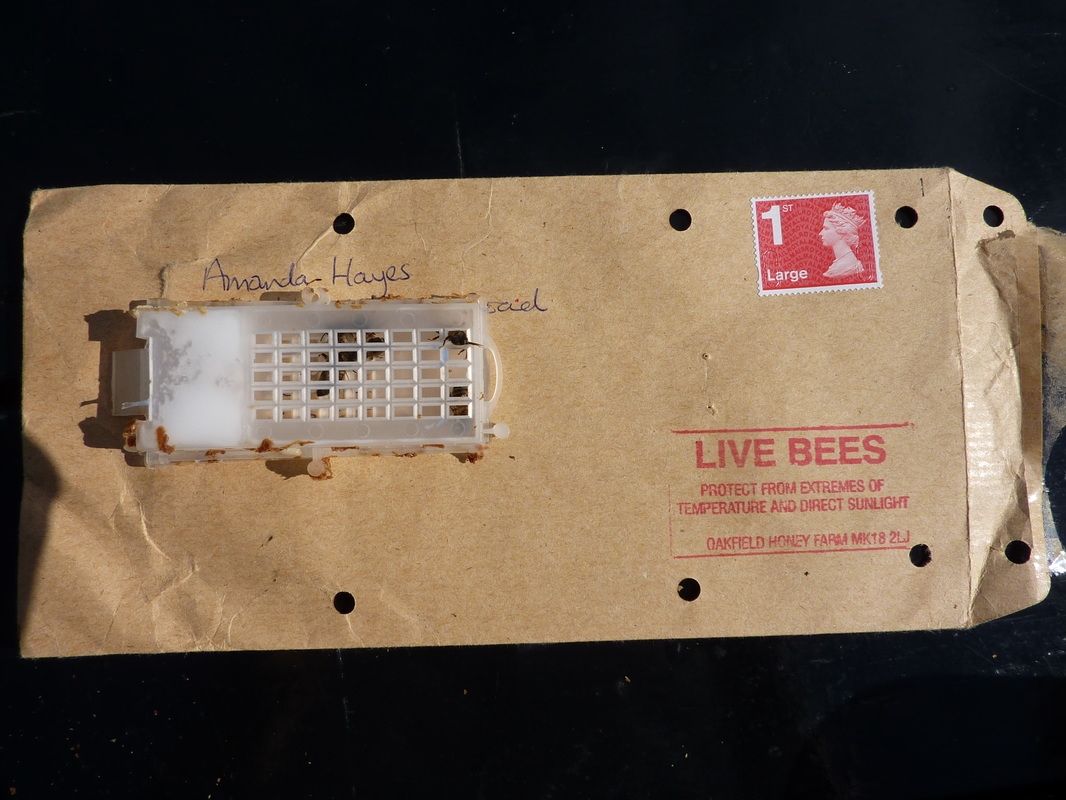
Day 1 - New queen introduced to nucleus 'nuc' hive.
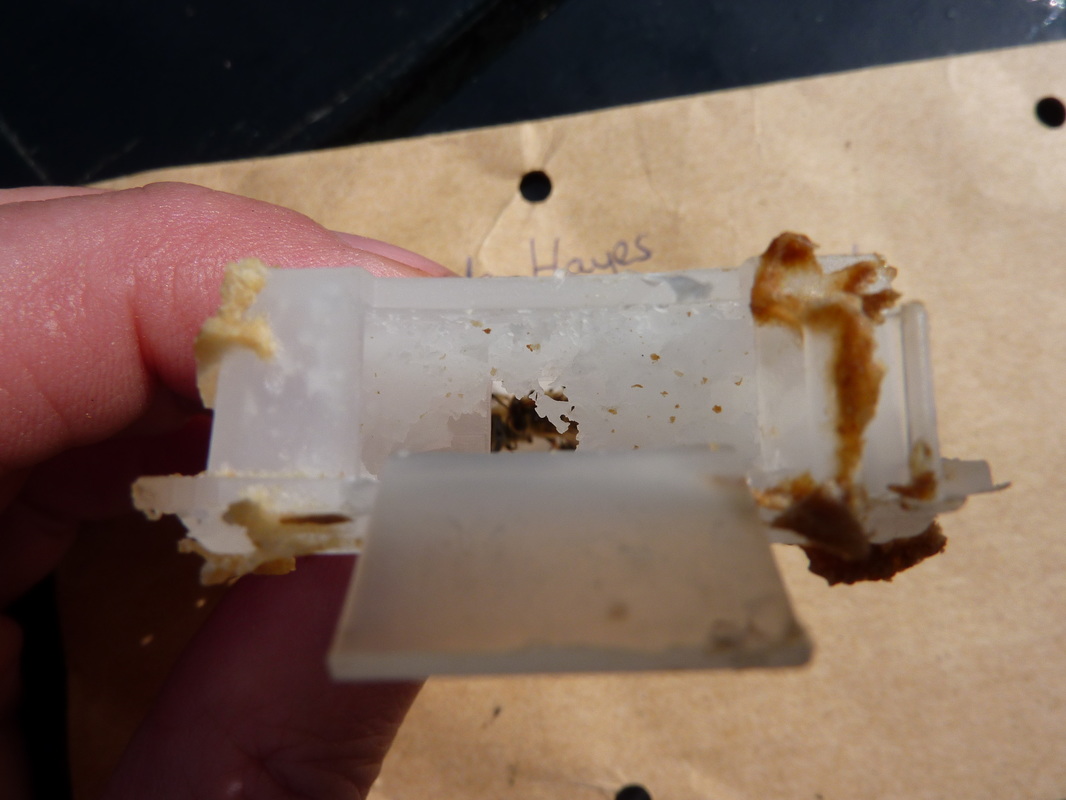
Day 2 - Checked nuc and found two workers drowned in syrup, removed. Fondant still in place in cage
Day 3 - Bees not going in and out of the nuc but then any 'fliers' would have returned to hive 1. A single bee on an orientation flight. Three dead drones in grass at entrance and one being killed by a wasp. Waited to see if any more wasps. No sign of guard bees at tiny entrance. Opened top to find one syrup death and rescued another bee. A peep at the queen cage showed big hole in fondant. Resisted looking at frames but only just !
Day 4 - British Beekeepers Association Examination so I was distracted. I checked for further bee deaths outside the nuc but all fine and then (deep sign of paranoia) I went on my hands and knees and checked the mesh floor from underneath to see if there were loads of dead bees and possibly the queen. All fine.
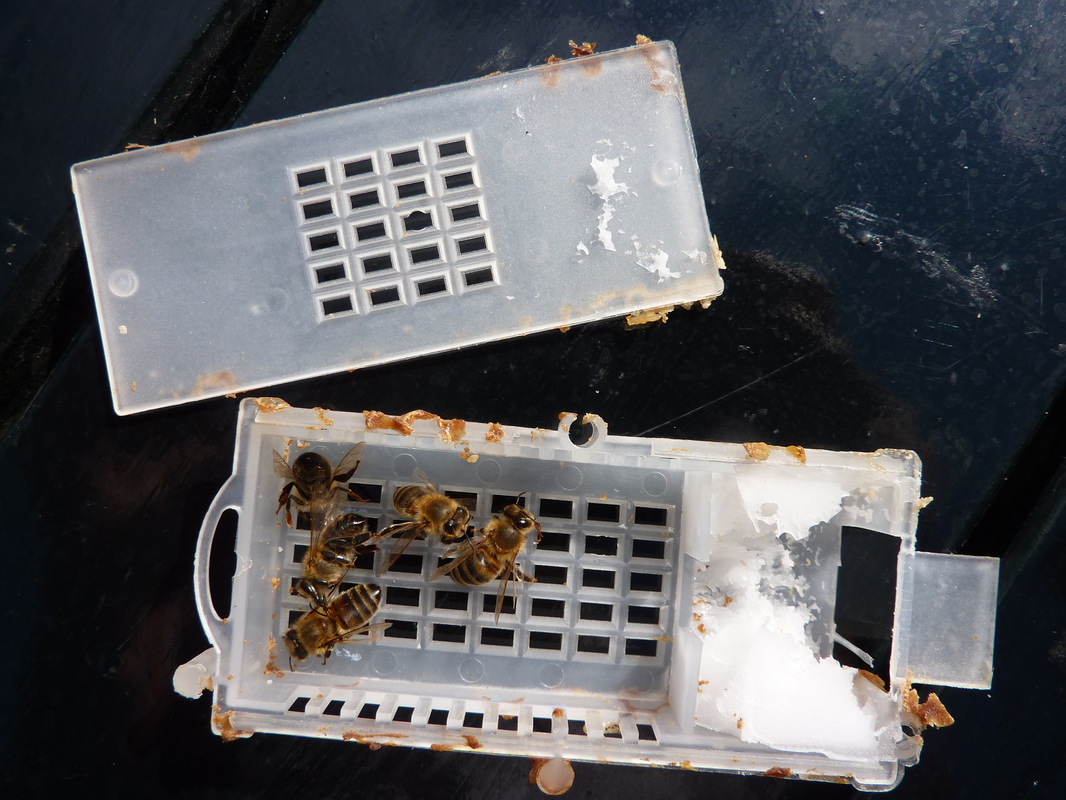
Day 5 - 1st Inspection day! No dead bees outside the nuc and still no entrances and exits. I lifted off the crown board in a high state of anxiety and carefully removed a frame of stores so that I could gently check the queen cage. This had a number of dead bees in it and I hoped that this did not include a rejected queen as my friend Alison warned me that workers can sting a queen to death through the cage. On closer inspection the bees looked like workers. I progressed with the inspection and found the azure queen walking around happily with her subjects. Phew! I nearly cried I was so relieved. No queen cups had been made in the period before the queen's pheromone had percolated the hive. Eggs seen but of course no new larvae yet as they have not had time to emerge from the eggs. The brood from hive 1 has been nurtured and a few workers were hatching out. The next bit of waiting will be to see if the brood from the new queen is building up well enough to go into a full sized hive. Also to see if the workers have matured into foraging bees. I was working in the garden in the afternoon and delighted to see about 30 worker bees on their initial orientation flights around the hive.
Day 6 - No orientation flights but a small number of bees exiting and returning to the hive. No sign of pollen so assume that they are collecting nectar or water.
Day 7 - Awoke at 6.00 am worrying if there is enough space for the new queen to lay as the nuc had 3 frames of brood and 2 of stores from hive 1. Very small number of 'fliers' leaving and entering the hive as yesterday.
Day 8 - Again a small number of bees circling the nuc. Are they 'robbers' ? they do not seem to enter or exit so what are they up to? 2.30 p.m. An active little group of orienteers are flying and moving in and out of the hive. Phew, relief. However, there are also a few crawling bees with deformed wing virus contracted in hive 1 via the varroa mites. These bees have been excluded and will sadly die. Hopefully the MAQs treatment means that newer bees are not affected.
Day 9 - 11 - Minimal activity especially yesterday as it poured with rain continuously.
Day 12 - 2nd Inspection day. Moved a full sized hive close to the nuc. Did a complete check of the nuc and saw the queen and eggs. Bees on 4 seams. Sadly a few on the mesh floor had deformed wing virus. I trust the newer hatched ones will be fine. Moved the frames from the nuc into the new hive with freshly waxed frames either side. They had eaten all the syrup so I topped it up and closed up the hive leaving a small entrance to make it easier to defend from intruders. From now on it will be external checks and syrup top up and weekly full inspection with the hope that there is enough time for this hive to build up sufficient numbers and health to see it through the winter.
Basic Assessment Examination
I am not sure why I decided to put myself through this as the Basic Assessment is not especially 'basic'. Inevitably things I had learnt did not come up and things that were not covered on the course 'emerged in conversation'. The assessment comprised making a frame which was OK as it was not so hot that the wax was 'soggy'. Inspecting a hive, which was not too bad as I managed to see eggs even without my magnifying glass and did not let any piece of equipment touch the ground. Thanks Johan, that frame hanger was a Godsend. even managed to catch a good number of bees from the entrance in a container. Not bad given that the apiary hives do not have landing boards! I can never keep the smoker alight and this is one of the assessment criteria so I stoked that old smoker up so it could have powered the flying Scotsman. Eventually the examiner took it away and filled it with grass to slow it up. I was highly amused but in a private way. As I went through the hive I was questioned closely and then had another hour of questioning. Generally it was OK but I had a couple of total blanks and made a right mess of explaining the Pagden Method of swarm control. Anyway, it took my mind of the nucleus hive! I now have to wait about a month for the results. I am not sure why it takes so long but presumably the assessor wants to be well away when they arrive. Not much fun telling someone they have failed when surrounded by bees.
Waiting, waiting, waiting ....................... agonising
I am not sure why I decided to put myself through this as the Basic Assessment is not especially 'basic'. Inevitably things I had learnt did not come up and things that were not covered on the course 'emerged in conversation'. The assessment comprised making a frame which was OK as it was not so hot that the wax was 'soggy'. Inspecting a hive, which was not too bad as I managed to see eggs even without my magnifying glass and did not let any piece of equipment touch the ground. Thanks Johan, that frame hanger was a Godsend. even managed to catch a good number of bees from the entrance in a container. Not bad given that the apiary hives do not have landing boards! I can never keep the smoker alight and this is one of the assessment criteria so I stoked that old smoker up so it could have powered the flying Scotsman. Eventually the examiner took it away and filled it with grass to slow it up. I was highly amused but in a private way. As I went through the hive I was questioned closely and then had another hour of questioning. Generally it was OK but I had a couple of total blanks and made a right mess of explaining the Pagden Method of swarm control. Anyway, it took my mind of the nucleus hive! I now have to wait about a month for the results. I am not sure why it takes so long but presumably the assessor wants to be well away when they arrive. Not much fun telling someone they have failed when surrounded by bees.
Waiting, waiting, waiting ....................... agonising


 RSS Feed
