Amanda Hayes
  • Blog
  • About
  • Contact
  • my website for Hackney Garden Honey

It seemed a good idea at the time!

29/6/2014

0 Comments

 
Picture
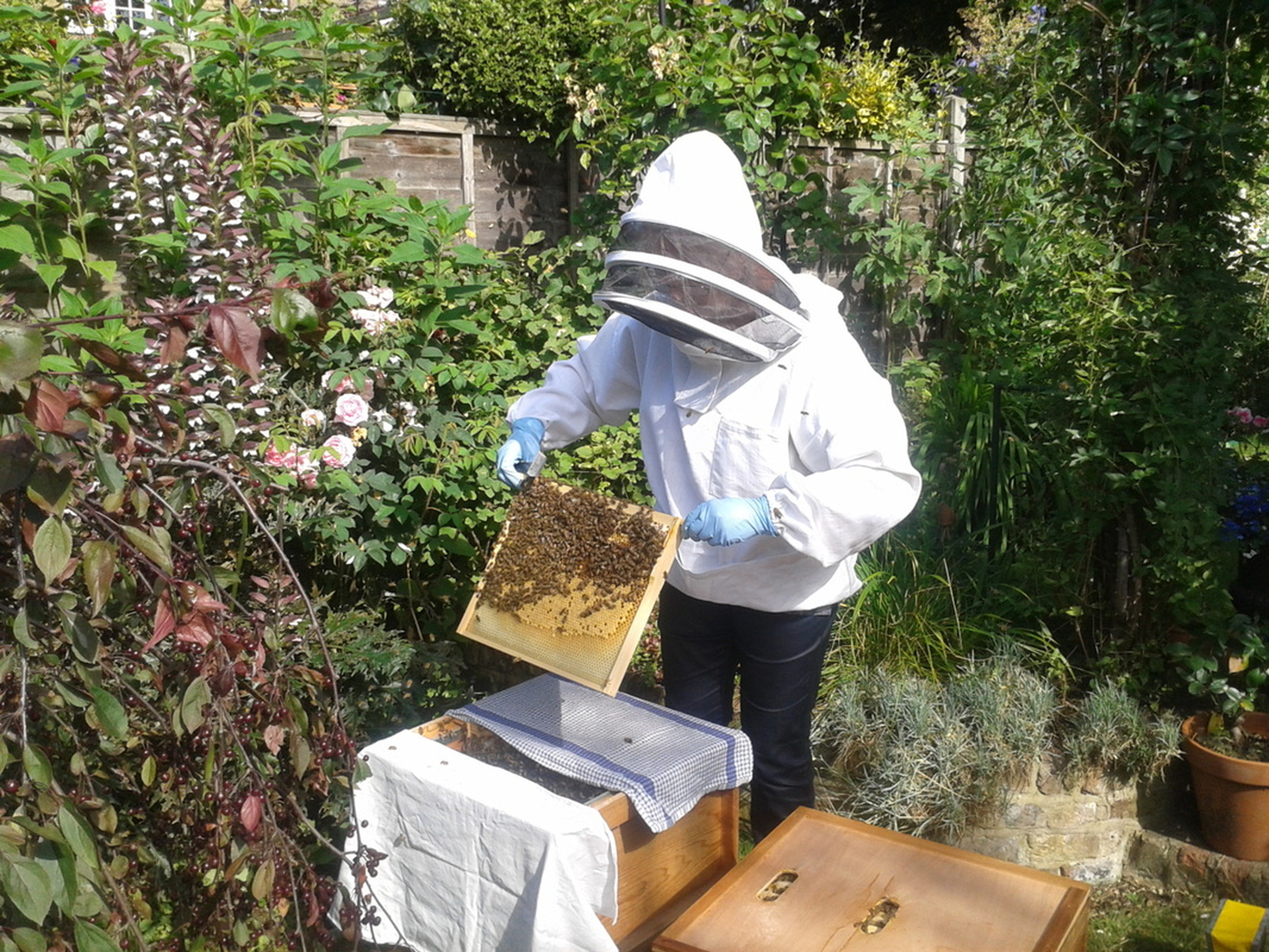
Inspecting my garden colony
My Garden Colony
On the varroa front I checked the 'fall' of mites onto the sticky board and counted 64 over 4 days.  Hopefully this is the MAQS working and as well as the external mites the ones lurking under the protection of wax in the brood cells are also being killed.  Time will tell.

There were some dead bees outside the hive and I sincerely hope that I have not lost brood or the queen which the manufacturers warn can happen.    I also trust that not disturbing the colony last week to check for queen cells was wise.  The MAQS instructions advise leaving any queen cells in case the queen dies .................... What on Earth am I going to find?

On Saturday I set up for my weekly check.  I lifted off the top super that weighed a ton - full of maturing nectar.  I then saw to my horror that the workers had filled the newly added super with 'freeform wax which was full of nectar.  When I added the super on Sunday I left a space in the middle to allow ventilation for the potent formic acid fumes of the MAQS.  The bees had ignored the frames with foundation and done their own thing.  I had to remove the wax dripping with nectar and brush off the busy cluster of bees from each piece.  I then took it into the house away from robber bees.  It started to rain.  Another abandoned plan .  Hm leaving the space had seemed a good idea at the time!

Early Sunday morning I decided to carry out the full inspection abandoned on Saturday.  Smoked the bees, lifted off heavy super no 1, lifted off lighter super no 2 now with all its frames of foundation.  Off with the queen excluder, no sign of the queen there.  Out with the dummy board, no queen.  Tea towel over the frames and carefully examined each one, no queen on any of them but brood in all stages but difficult to see eggs even with magnifier.  Quite a few clusters of bees where a queen cell or queen might be obscured. I went back through each frame shaking off bees to see if there were any queen cells (indicating that the workers are growing a new queen), or the good lady herself,   I got back to the last frame where queens tend not to lay and saw a a queen-like body run through the frame to the other side.  I turned the frame and there was a queen without a big green dot.  Is this a new virgin queen?  where is the old one? Careful examination revealed a small amount of green on her thorax ................ aha now I know why I couldn't find my green queen for three weeks, she is no longer green!  I shall have to re-mark her next week to make spotting her easier.  This is quite exhausting.

Back in the house I tried some of the immature honey gathered yesterday.  Flowery, delicate and totally magic.  Let us hope that I will have a few pots to share at the end of the season in addition to 30lbs left for bee winter feed.
'
At the Kenwood Apiary

My hive survives but is a bit puny.  I marked the queen who is now laying.  This was a bit fraught as she was running around and I had to capture her in a spikey ring without stabbing her and then hold her still by pressing the ring down.  The pen was dry, the other bees crawled everywhere and I had to press down to stop her getting away but without damaging her legs or abdomen ..................... seemed OK but we will see next time!

My little apidea with a new 'laying queen' was introduced into another queenless hive using the 'Artificial Swarm' technique.  Too much to detail here but yet another great learning opportunity,  Lets hope I remember and can apply this knowledge when I have to do this on my own.


0 Comments

Creeping Death

23/6/2014

0 Comments

 
My home bees have a high level of varroa mite infestation and if left untreated there is a 'severe risk' FERA of losing the colony.  Varroa is a nasty parasite that has been a problem in the UK since 1992.  It grows in the cells, clings to the bee, sucks its blood and can transmit a virus that results in deformed wings in newly emerging bees.  It cannot be eradicated but it can be controlled .................

When I first got the bees I put a varroa floor into the base of the hive and counted a drop of one or two mites per day.  This is in the 'tolerance level' but I gave them a dusting of icing sugar to encourage them to clean themselves and to make it more difficult for the mites to grip.  The bees flew around like little white ghosts.  I took the varroa board out as it should not be left in as it impedes ventilation in the hot weather.

I attended an apiary session on managing varroa.  I obtained the FERA publication and diligently put together an 'integrated management plan' that includes: biotechnical methods, use of varroacides.  First strategy was to have some shorter frames in the brood box.  The bees tend to produce drones at the lower edge of each frame and once this had happened in the 'free-form' comb, I planned to cull the drones.  It sounds awful but the varroa gravitate to these cells as they take longer to hatch than queen or workers and it is a good way of getting rid of varroa without the use of chemicals (see earlier blogs).

I was busy  gardening last week in the sunshine feeling happy in my 'bee loud glade'.  The bees were very active and I was thinking of adding another super for honey stores.  From time to time I came across a bee on the lawn.  Some were taking the nectar from clover but some were just wandering.  I picked them up and examined them.  At first I thought their wings were damaged through wear and tear and that the bees were coming to the end of their natural lives.  I am sure that this was the case for some of them.  I then began to wonder if some could be suffering from deformed wing virus .................. back in went the varroa board and to my horror over the first three days of monitoring the drop was in the severe risk category on the FERA calculator ie ave 14 mites per day.

I decided that the only way forward was to use chemicals and spoke to a couple of experienced beekeepers to check my plan.  So there goes another £100 order to Thornes which included the MAQS strips of formic acid.  I read and read, watched the video, checked the weather forecast (you must not use if too hot), gritted my teeth and in the cool of the evening put the strips in under the queen excluder and over the brood frames, then added an empty super for extra ventilation.  Not sure about the bees but I nearly passed out from the fumes!  The instructions warn that you may have some loss of colony including the queen - not what I wanted to read.

The weather forecast was wrong and it was hotter than predicted and I began to worry as the mercury rose ....... there were plenty of bees flying but to be honest I don't blame them wanting to get out of the hive.
  On day 3 I put the varroa board, smeared with vaseline to catch the mites, on the ground under the hive as I did not want to reduce ventilation.  I am resisting the temptation to look at the board every few minutes.  I have not opened the hive.  All will be revealed on Saturday and hopefully the mites will have been killed in the cells,  the bee larvae have not been and the queen is happily laying eggs AND I SEE HER!

So another week without pictures


0 Comments

The Lady Vanishes

15/6/2014

0 Comments


Better news at Kenwood Apiary this week.  I have a new queen and there are eggs and larvae at all stages.  Lets hope that this queen stays and the colony now puts their energies into building up numbers and stores so that they are in a strong position to over-winter.  If they have some surplus honey for me then that is a bonus and at least what I deserve after the run-around they have been giving me.

The other hives in the apiary seem to be calming down.   The apidea mating hive we created seems to have produced a new queen and the nucleus hive too.  Now we need to see if the queens have been properly mated and are laying copious numbers of workers.  Last year because bad weather delayed the nuptial flights many people ended up with drone laying queens resulting in colonies needing re-queening and delays in brood and low honey production.

Yesterday at home we had hide and seek again.  I went through the frames in the brood box twice and could not find the queen.  This time I used a tea towel over the frames each side of the one I was inspecting to keep it dark as the queen runs from the light.  There had been a build up of free-form wax like the Metropol Parasol in Seville and they are not even Spanish bees!  I had left it for 'sacrificial drone brood' to cull varroa mite that gravitate to these cells but the bees had not got this far and a piece broke off and fell on the hive floor.  After not finding the queen I sent my husband for the barbecue tongs and managed to fish out the broken comb and was stung through my glove - comb and sting both removed successfully.  The good news is that when I examined this piece of broken comb I could clearly see large and small larvae and then eggs which means the queen must have been around in the last couple of days.

Last week somebody told me to smoke the top as well as the bottom of the hive to drive the bees down making it easier to examine the frames.  Today somebody said not to as it may have driven the queen down ................  It is so difficult being a novice as everyone gives advice, often conflicting.  I have come to the conclusion that the only ones who know what they are doing are the bees!

Must get the photographs sorted o

0 Comments

Find the Lady

7/6/2014

0 Comments

 
This week's visit to the Apiary at Kenwood House was very problem-centred despite the fact that I had made delicious lavender biscuits to share with the others! We looked through my hive several times and got the apiary manager to look too but no sign of my new green queen.  My little colony had been getting on well but I am afraid that adding some brood frames from the 'swarmy' and depleted 'hive 2' last week may have added an unfortunate dynamic to my colony.  Although there was capped brood I could not see any eggs so unlikely that the queen is hiding and more likely that she has left the hive. The workers were not agitated and were busy but I will need to do something radical next week as a queenless colony is a doomed colony.

On another queenless hive the bees were not happy with the actions that the beekeepers were taking and we ended up with some very angry bees
.  Hiding in the club-house was not enough as the windows were open.  Several people were stung (not me).  Attacking bees have to be killed or they will sting you later when you have your protective clothing off.  Lots of smoke to masque the bee attack pheromone, action to remedy the underlying issue - queenless bees united with a colony with a queen cell.  This is a very swarmy year leaving small 'anxious' colonies.   Too much excitement for one day!

My home hive has been lively all week.  I did my weekly inspection this morning and could not find the queen ....... but found a poorly formed and open queen cup with no larvae which is a sign that the workers are messing about making 'play cups' or I have a problem.  I went back through each frame in the brood box but no sign of the queen and as it is quite a small colony without thousands of bees I began to worry.  I went back through each frame again and looked on the walls and floor of the hive, still no sign .......... There were no proper queen cells which I would expect if my queen had left and a new queen was awaited but after losing a queen on thursday I began to get very anxious.  It was starting to rain and the bees were now getting a bit lively and my smoker went out and then there was my naughty queen on the next frame I looked at the end of the second run of frame checking.  The plan for today had been to inspect drone brood for varroa mite infestation but was not to be as closing up and calming bees and myself down was the priority - and a cup of tea (for me).  Next week no hiding the queen and no making pretend queen cells please girls - beehave yourselves.


0 Comments

Red Queen Hypothesis

1/6/2014

0 Comments


Yesterday morning I did a full inspection of my home hive and all was well.  I removed the entry block as the colony is developing well and the weather is warmer thus the sentry bees should be OK with guarding the entrance from robber bees and the larger entrance will help ventilation of the hive.

In the afternoon I went with some other NBA members to visit the apiary of an experienced beekeeper.  The theme of the session was varroa mite control.

I met the others at the gates to St Pancras Cemetery.  We made our way through this huge place to where John has his apiary.  It is well out of public view and the hives are hidden within a sea of tall comfrey flowers.  After putting on bees suits and getting the smokers going we inspected his hives checking the 'drop' of mites on the varroa boards and culling some drone brood to see how may mites were sucking the life out of the larvae.  The numbers on the boards and in the brood were small.  However, during the afternoon I looked down to see a queen bee marked with a red dot on my shoe.  It seems that John had lost a queen cage at the last inspection.  We found the empty queen cage in the hive I was looking at.  She had eaten all the fondant in the cage and escaped and then somehow ended up on my shoe.  Lucky I saw her.  It was all a bit bonkers with 11 people crashing around in the jungle of plants in astronaut kits puffing smoke and trying not to fall off the pallets that the hives were standing on.  A good learning experience.  I now need to plan my anti-varroa routine for the year. 

It is interesting that the Red Queen Hypothesis concerns an evolutionary arms race where prey and predator constantly evolve together to reach some sort of uneasy balance - honey bee and varroa mite in this case - how appropriate that a red queen bee landed on me!

0 Comments

    Hello, for many years I have been a passionate gardener and have encouraged wildlife into my urban garden.  Three years ago I joined a Beekeeping Association.   Last year I installed a beehive in my garden and started this blog to record my  experiences.


    Archives

    July 2015
    May 2015
    April 2015
    March 2015
    January 2015
    November 2014
    October 2014
    September 2014
    August 2014
    July 2014
    June 2014
    May 2014

    Categories

    All

    RSS Feed

Powered by Create your own unique website with customizable templates.
Photos used under Creative Commons from kaibara87, U.S. Fotografie
